So you’ve got a song – or collection of songs – that’s ready to record. Maybe it’s just an idea, or perhaps you’ve already recorded some demos at home and are looking for a studio that can really bring your vision to life.
If this is your first time working with a recording studio to produce your music – or your first time recording your work at all – the whole process can seem a little daunting. Here’s what you should know in order to make the most of producing your music at a recording studio.


Phase 1
Before your session at the recording studio
First thing’s first, it’s important to have a clear idea of what you want the end product to sound like so that you can be well prepared to make the most of your studio time.
Step 1
Composing: developing a vision of your sonic world
The questions you’ll need to ask yourself while composing range from concrete – what’s the instrumentation? – to abstract – how do you want your listeners to feel?
What instruments will you be using?
What are the basic elements to your composition? Vocalists, drums, guitar, base, trumpet, cello? Glockenspiel? These might be the first questions you answer, or you might wait until you have a clearer picture of the piece’s emotional tone.
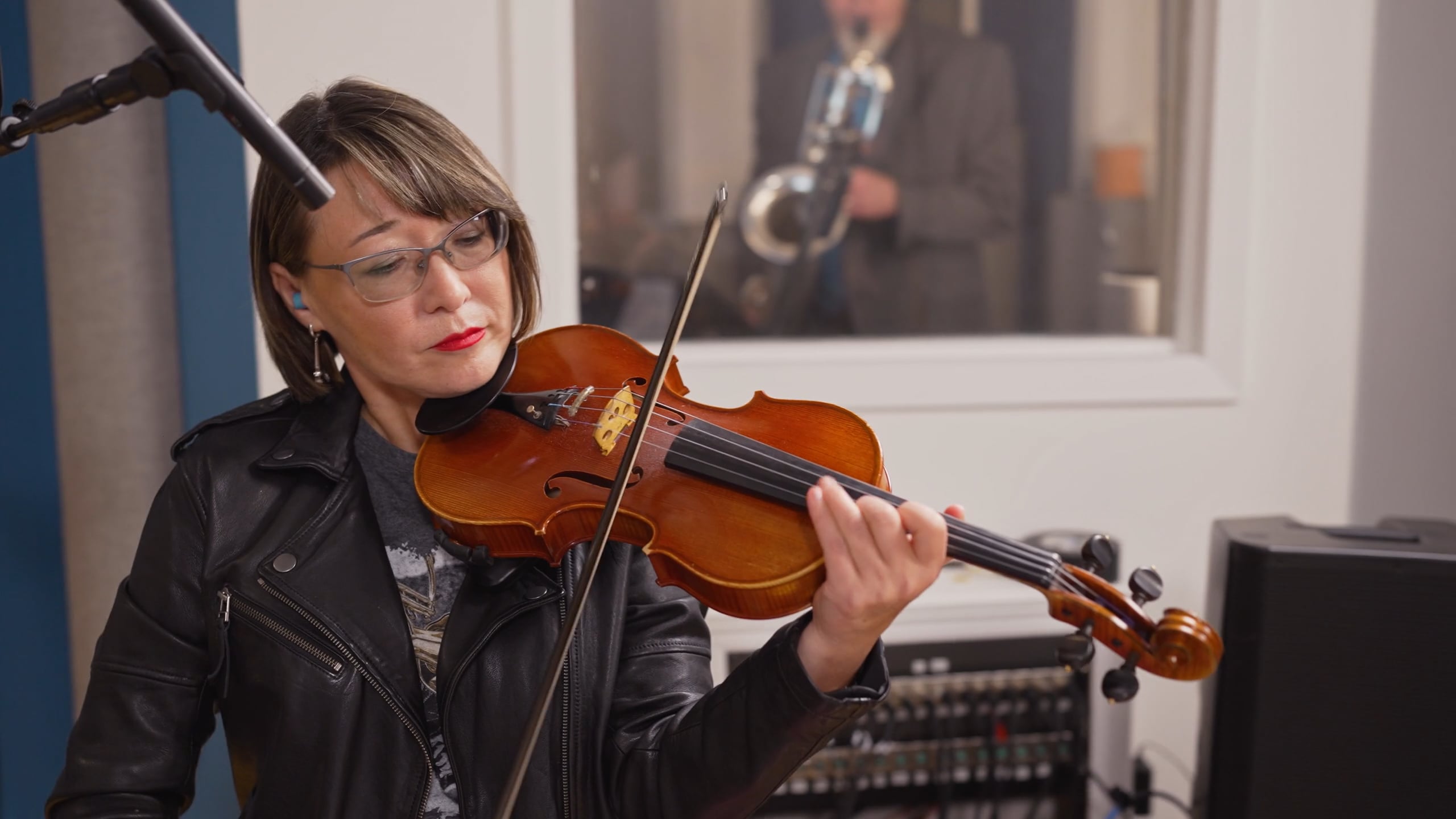
Elena Lukina plays violin during a live tracking session in our tracking room. Behind her, you can see Richard Zelinsky on baritone saxophone in the ISO booth.
Either way, tell your recording engineer what your instrumentation is before your session. Some instruments play nicely together when recorded in the same space, others do better when isolated, so knowing this in advance will help them have the studio ready to roll when you arrive.
Dream up your sonic world & be able to communicate it
What do you want the end product to sound like? What sort of feelings do you want your song to evoke? Consider creating a moodboard that will help your collaborators get a sense of what you’re going for. Who’s your inspiration? Do you like the highly produced sound of a studio album, or are you more into the organic, stripped back vibes of a live performance? Send these references to your engineer before your session so they can set up the right gear to capture the sound you’re after.
No matter what you dream up, don’t forget to dream big. A recording studio is a sonic playground: it’s made to capture sounds you can’t get anywhere else. Beware “demoitis” – that is, getting so used to the way your song sounds in its current iteration that you’re not willing to take creative risks while recording.
Not sure? Work with a producer
If you’re having a hard time coming up with answers to these questions, or if you’re unsure about what’s even possible in a recording studio, consider working with a producer. Producers help artists bridge the gap between the technical and the creative, and help to ensure the final product matches with – or even exceeds – the artists’ original vision. While it’s not a requirement (plenty of artists will skip inviting a producer into their project), their unique expertise can be instrumental in helping a project reach its full potential.
If you need any help answering the above questions, or are interested in having Derek Haukaas produce your project, give us a call! We’d love to hear what you’re working on!
Step 2
Choose your collaborators
One of the joys of music is how collaborative the art form is, but every artist knows that the success of a project can depend on how well you click with your co-creators. Making sure you have the right people working with you is really important!
Musicians
If you don’t have a band but your composition calls for more instruments than you can play yourself, you’ll likely need to hire session musicians. If you let your recording studio know what you’re looking for, they will likely be able to get you connected with the right players.
Can’t find anyone? You can always use samples or virtual instruments to fill in the gaps. At Frostline, we prefer to record live instruments whenever possible because they offer the highest quality sound and the most flexibility in the mixing process. No matter what you use, though, you should send your recording engineer any already recorded elements before your session.
Studios, engineers, etc.
Think of the studio as a venue and your engineer as another member of the band. Making sure you feel comfortable in the space and understood by the engineer is just as important as the studio’s equipment quality or the engineer’s expertise level.
Beyond making you feel comfortable, you need to be able to trust that your engineer can see your vision and knows exactly what to do to achieve the sound you’re looking for. For example, they may suggest – in order to get that specific, stylized tone you’re after – for you to use the studio’s instruments instead of the ones you brought. Having confidence in your engineer’s expertise makes stepping outside of your comfort zone like this much easier. For that reason, it’s a good idea to meet your engineer at the studio before booking a session to determine if it’s a good fit.
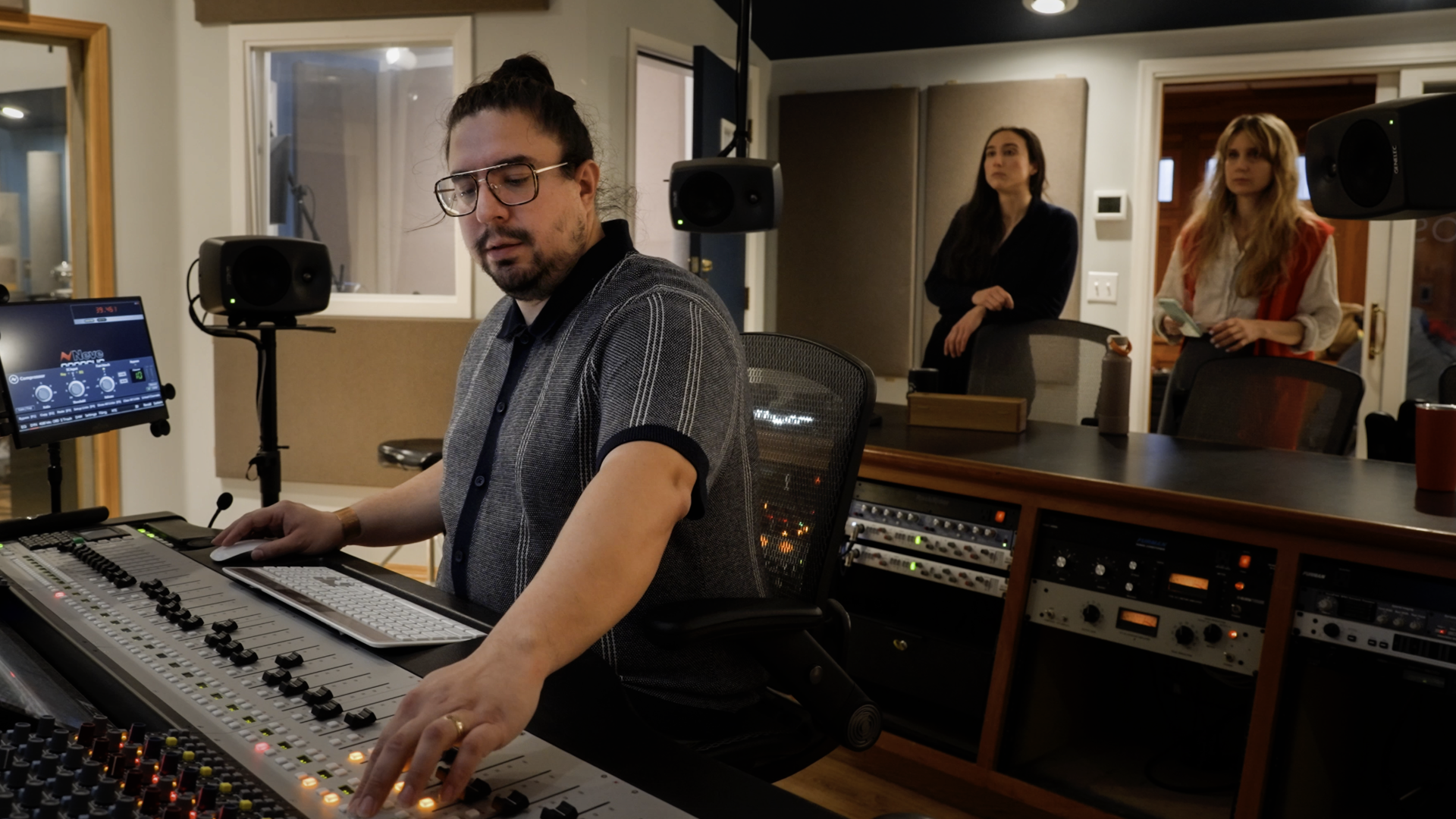
Artists collaborate with Senior Audio Engineer, Derek Haukaas, during a tracking session at Frostline Studios.
Step 3
Prepare & practice
A lot of artists like to compose and record simultaneously: sketching out ideas, listening back, and rearranging as they go. But when you’re paying for studio time by the hour, that can get expensive, fast. If you’re well practiced, you’ll be able to lay down the base tracks in no time, giving you the space in the remainder of your session to get creative. And that’s when songs can start to take on a whole new life!
TIP: As you’re preparing, create simple demos (even just using your phone’s voice memo app). This can help a lot to give you an idea of how some of the big picture arrangement choices are translating to recorded format.
As you practice and your ideas develop, share any updates with your recording engineer so they, too, know how to prepare. Remember, your engineer is more than just a technician – they’re a collaborator!

Phase 2
Tracking
The big day is finally here! Though every tracking session is as unique as the songs being recorded, here’s more or less what you can expect.
Step 1
Load in & sound check
Show up, get settled. You might load in the night before if you’ve got an early start and have large, complicated instruments (like drum kits). If you’ve kept your recording engineer up to date, there shouldn’t be too much more to do before tracking on the day of your session. After a sound check to get the levels just right, it’s time to record!
At Frostline, we recommend drummers use one of our eight house kits, which have all been tuned specifically for our tracking room. Just let us know the sound you’re going for, and Derek (our Senior Audio Engineer who is also a drummer himself!) will put together a kit that’ll sound exactly how you want.
Step 2
Recording
Depending on how you want the finished product to sound, you might play to a click track and layer all the elements individually, or track everything at the same time. You can also mix and match these techniques – i.e. track drums and bass together to get the rhythm down, and then layer on vocals and other elements.
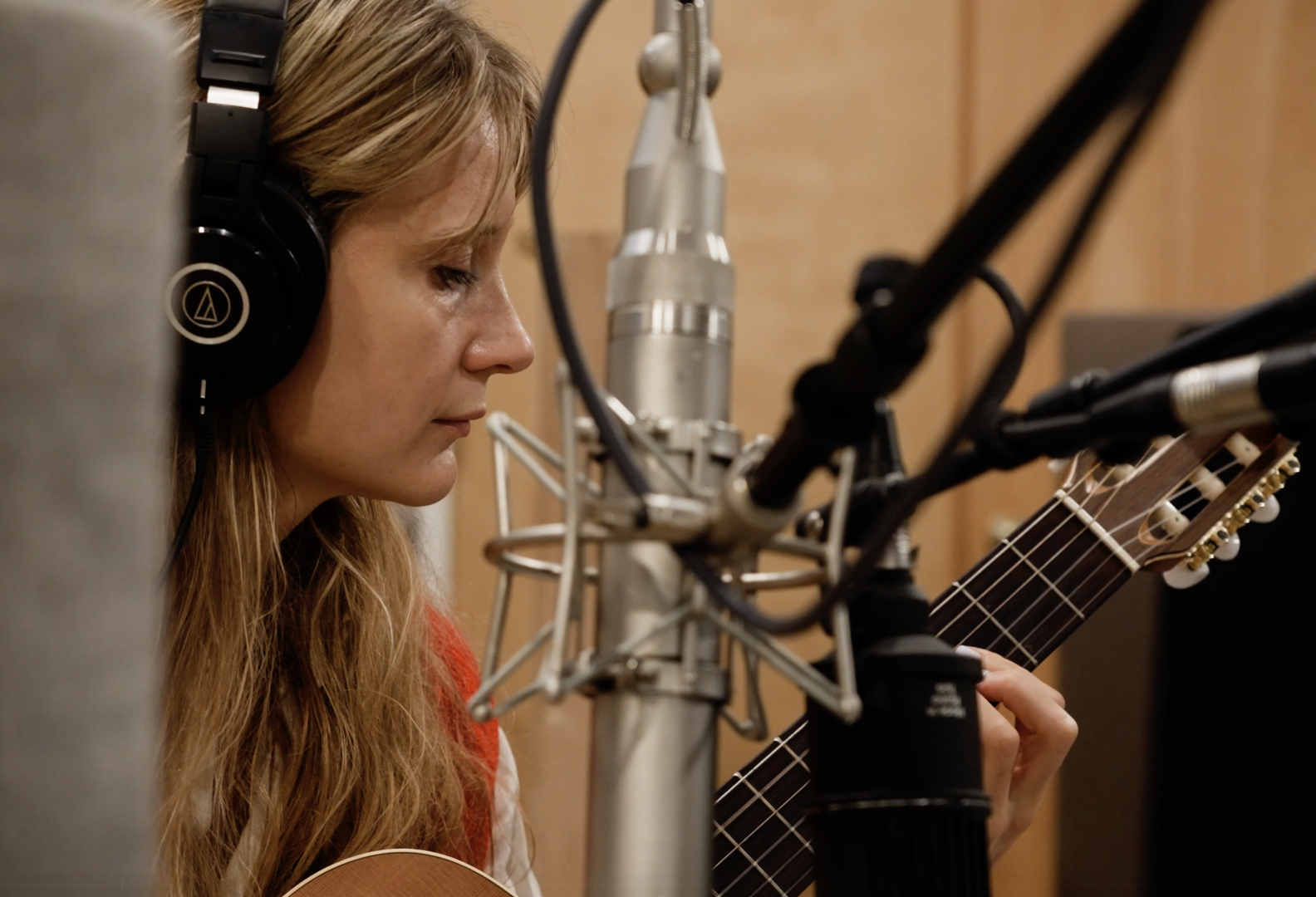
Keeley Boyle tracks guitar in Frostline Studios’ live room.
Playing to a click track
If you want a very clean and polished feel, it’s a good idea to play to a click and track each layer separately. Playing to a click helps everyone stay on tempo when not playing together, and makes editing and comping easier later on in the process. Recording this way will also help keep the tracks really clean, meaning you’ll have more flexibility to apply interesting effects in the mixing phase.
Playing all together
On the other hand, some artists prefer to skip the click and record everyone at once, allowing the musicians to feed off each other’s energy and achieve a more organic, live-sounding performance. Tracking everyone at once in the same room, however, means that audio tends to spill-over or “bleed” into the open mics on other instruments. This audio bleed can give a lot of energy and momentum to a recording, but it may limit what can be done in the mixing phase of the process.
The Spenard Jazz Messengers play all together in a live studio performace. Richard Zelenski is isolated in the booth to prevent excessive bleed from his baritone sax into the other mics, but can still see and hear everyone else.
Whether you’re using a click track or not, you’ll likely start tracking with your rhythm section and/or the other instruments that form the foundation of your arrangement. You’ll do multiple takes of each element, so make sure you’ve booked enough time to get through everything.
Once you’ve tracked your core instruments, you’ll have time to get creative. As opposed to live performance where what you hear is more or less what you get, working in a studio allows you to experiment with different mics and other recording equipment to capture unique sounds and interesting effects. This is your space to dream big!
Step 3
Comping, overdubs & arrangement
Doing multiple takes allows you to select the best performances through comping. Maybe in the first take you played everything except that one tempo change perfectly. In take two, you nailed the tempo change, but messed up a chord on the first chorus. When comping, you use all your takes to stitch together the best possible version of a track.
After comping, you can give your piece a richer, more rounded-out sound through overdubs – layering in harmonies, correcting lines, and adding in “ear candy” moments. You can also play around with the arrangement, tinkering with where each element sits to discover the most effective structure for the song.

Phase 3
Mixing
Once all of your elements are settled where you want them, your mixing engineer will clean up the recordings and refine everything further. First, they’ll remove extraneous noise and fix minor pitch and timing inconsistencies – if you want them to, that is. Then, they’ll really start to bring your sonic world to life through balance, effects and automation.
Building the sonic world:
Balance, Effects & Automation
Your mixing engineer will adjust levels, EQ, and compression to make sure the instruments don’t clash or overpower each other, and that the piece as a whole is balanced sonically. Additional effects can manipulate the sonic environment in subtle ways to help everything feel like a cohesive whole, or in more agressive or creative ways to achieve a stylized sound.
Keep in mind that intentional EQ and effects choices made during the mixing phase can be an extremely effective way to enhance the emotion of a piece. Go back to the moodboard you created while composing. Ask yourself: what emotions did I want to tap into with this song? Is the song achieving that? If not, tell your engineer. They might have ideas for effects they can apply to enhance those emotions in the mix.
For example, if you’re trying to convey vulnerability, you might have the vocals positioned really close to the listener in the sonic space. On the other hand, you could make something sound aggressive or unsettling by purposefully introducing imbalance to the mix.
Through automation, all these adjustments can be programmed to happen over time to really give depth to your sonic landscape. For example, you might adjust an effect to slowly come in over a track so it sounds like you’re slowly coming into the room where the instrument is being played.
Immersive mixing options
Mixing is also when your song will be tailored for different playback systems and listening experiences.
Stereo mix
Since the 1970s, most music has been mixed in stereo. In a stereo mix, all the elements in your song are summed into a single track with left and right channels, where the spatial placement of your elements (i.e. where they sound like they are in relation to the listener) is confined to those two channels.

Audio objects float in space in the Neve Genesys G3D’s Dolby Atmos interface.
Dolby Atmos mix
Dolby Atmos, like most surround sound formats, initially came onto the scene for use in movie theaters, but is now becoming more and more popular for music. What makes it different from other immersive audio formats (the same thing that makes it exciting for music lovers) is that its dimensionality is based on 3D space instead of channels.
Previously, surround sound formats were based on channel counts (one for each speaker in your playback system). This greatly limited where immersive mixes could be played. A 5.1 mix, for example, can only be played on a system with five speakers and a subwoofer. In order to truly enjoy an immersive mix of a song, then, a listener would have to have a specialized room and playback system with the right number of speakers – and while those listeners are out there, that’s a still a pretty niche market.
On the other hand, Dolby Atmos’ spatial programming isn’t based on a specific channel count, meaning it can fold down and play on pretty much any playback system. This versitility finally made immersive audio feasible for music lovers everywhere: one mix for your number one fan with a dedicated listening room and the casual listener streaming your music in their headphones while at the gym.
Along with this versatility, Dolby Atmos also has a wider dynamic range. Now, when placing elements in your mix, you have a full 360° field of 3D space to work with, instead of being limited to cramming sounds into just two channels. Without having to compete for space in a limited number of channels, there’s so much more room for all the details to shine: quiet moments are more delicate and loud moments just hit harder. Whether your playback system has 215 speakers like the Dolby Theater in Hollywood, or just two like your headphones, each element is given room to breathe.
With the installation of the Neve Genesys G3D mixing console – the first of its kind to be shipped from Neve’s factory in the UK – Frostline became the first and only Dolby Atmos certified facility in Alaska.
If you want to experience what Dolby Atmos is all about, come by the studio! We’d love to give you a demo.
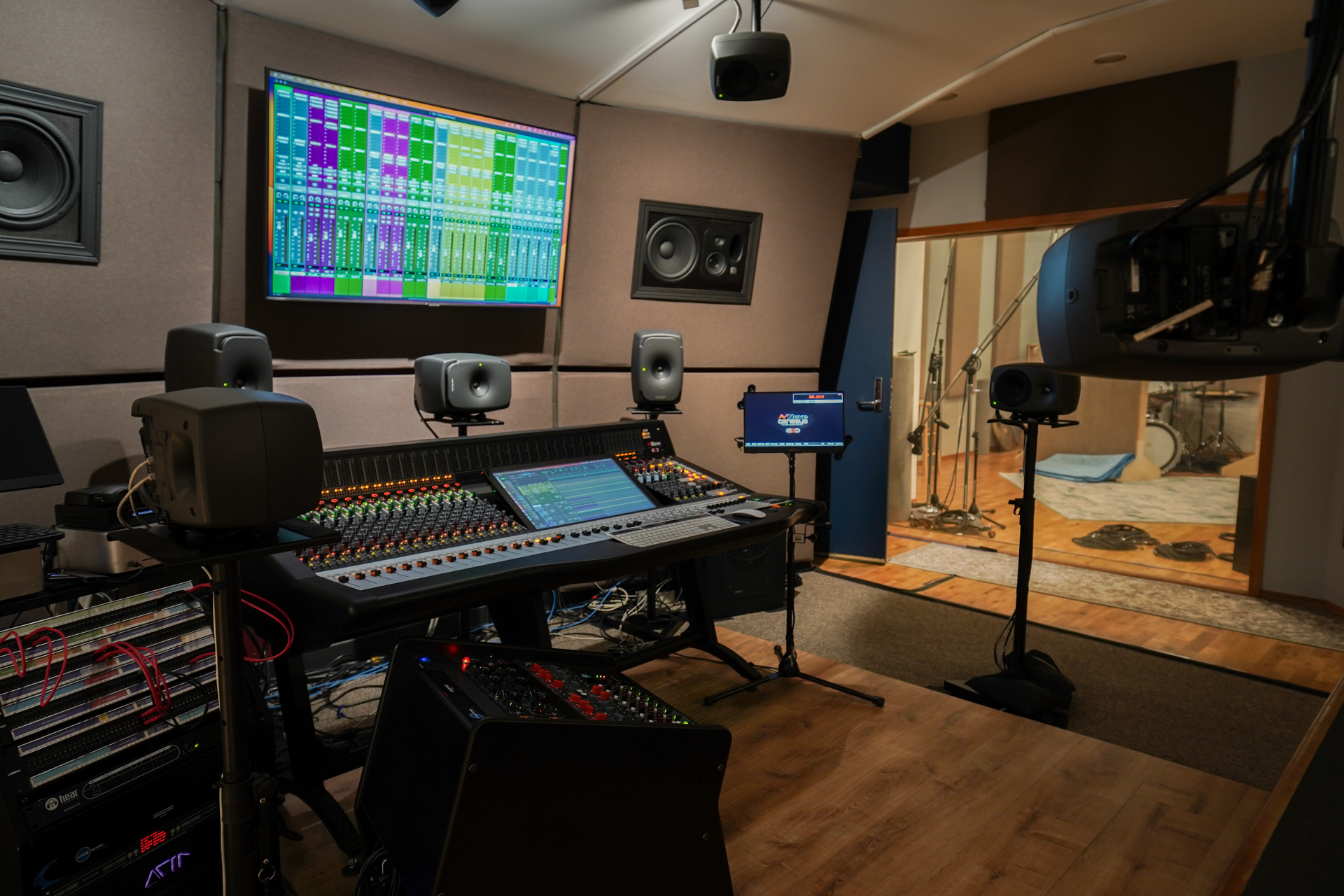
Our Dolby Atmos mixing station in the control room at Frostline Studios. Note the sphere of speakers surrounding the “sweet spot.”
Phase 3
Mastering
Once you’re happy with the mix, your mastering engineer will give the project as a whole a final polish with an eye on the following things:
- Uniformity: They’ll make sure your track sounds good no matter where it’s played by testing it on a number of playback systems and making adjustments where necessary.
- Cohesiveness: If your project includes a collection of songs, they’ll also apply adjustments to ensure they sound like they belong together.
- Preparation for distribution platforms: Distribution platforms have specific loudness standards they require for your files. Your mastering engineer will make sure yours are up to snuff for wherever you’re releasing your music.

Phase 4
Releasing
If you’re working with a label, you’ll collaborate with them on the next steps. But more likely than not, you’re an Independent musician. That means you’ll have to put in the legwork yourself. Exactly how you market and distribute your music is up to you, but if you hope to earn royalties, it’s a good idea to sign up for a Performers Rights Organization (PRO) and use a distribution platform to get your music listed on streaming services.
Performers Rights Organizations (PROs)
Performers Rights Organizations like ASCAP or SESAC help ensure artists get paid when their songs are played on the radio, streaming platforms, or in public. PROs grant licenses to use your music, track when and where songs are played, and collect and distribute your royalties. When you sign up for a PRO, you’ll be given an Interested Party Number (IPI), which will be used to connect you to your work.
Distribution platforms
Once you’ve registered with a PRO, it’s time to get your music out there! A distribution platform will do the bulk of the work by assigning the codes used to track your music and sending it out to get listed wherever someone might want to listen. You just have to upload the files, cover art, titles and credits (including the IPIs of anyone with ownership of the song), and they’ll handle the rest.
Popular distribution platforms that will send your work out to streaming platforms include platforms like CD Baby or DistroKid. For more direct control over the purchase of your music, you can use platforms like Bandcamp.
Every project will go through a slightly different process, but this should give you a good idea of what to expect. You might choose to work with the same engineer the whole time, or get input from a different one at each stage. It’s your project – it’s up to you!
Ready to get started? Frostline Studios is a full-service recording studio, meaning we cover all stages of the process (except release). Give us a call: we’d love to hear what you’re working on!
MANTHA PRATT‘s love of storytelling in all its forms started young, with adventures in books and Alaska’s great outdoors. It grew into a deep curiosity about people, cultures, and the way we communicate that led them to pursue a BA in Communications from Lewis & Clark College.
Like everyone on the Frostline team, Mantha wears many hats. Their knack for organization and designing solutions to stubborn problems keeps Frostline running smoothly so that the rest of the team can focus on doing what they do best. In addition to administrative tasks and production coordination, Mantha manages Frostline’s online presence, and occasionally joins the creative team as a graphic designer. They write our blog and produce our podcast, Hold for Sound: Let’s Talk Media Production.
At home, they enjoy going on dog walks, discovering new and local music, and baking pies.
DEREK HAUKAAS‘s passion for helping artists’ voices shine via top-quality audio in both music and film has earned him 2 Emmy® Awards and a Rasmuson Individual Artist Award. He’s a sorcerer of sound down in Studio A, where all the audio magic happens.
Derek has travelled the state as a Location Sound Operator with British comedy host Sue Perkins for BBC Channel 5, engineered vocals with Portugal. The Man, and run ADR sessions for HBO’s True Detective: Night Country. Beyond those, his extensive list of credits include film projects such as The Great North (FOX), Alaska Daily (ABC), Sweet Tooth (Netflix), and North of North (CBC, Netflix); podcasts like REI’s Wild Ideas Worth Living and James Dommek Jr.’s Alaska is the Center of the Universe; and work with musicians such as Ya Tseen, Taylor Dallas Vidic, Medium Build, Josh Ritter, and many more.
His passion for music started in his childhood, growing up in rural Alaska. He loves living in Alaska and is inspired by the the state, its people, and culture. After graduating with a degree in Music Performance, Derek has dedicated his life to serving Alaska’s musicians through his work. In his time off (and often while on the clock, too) Derek can be found jamming out behind one of his eight drum kits. When not playing music, he enjoys eating good food, four-wheeling, and subsistence hunting and gathering with his family.